CME: Medication Management of Adult Attention-Deficit/Hyperactivity (ADHD) Disorder in Primary Care
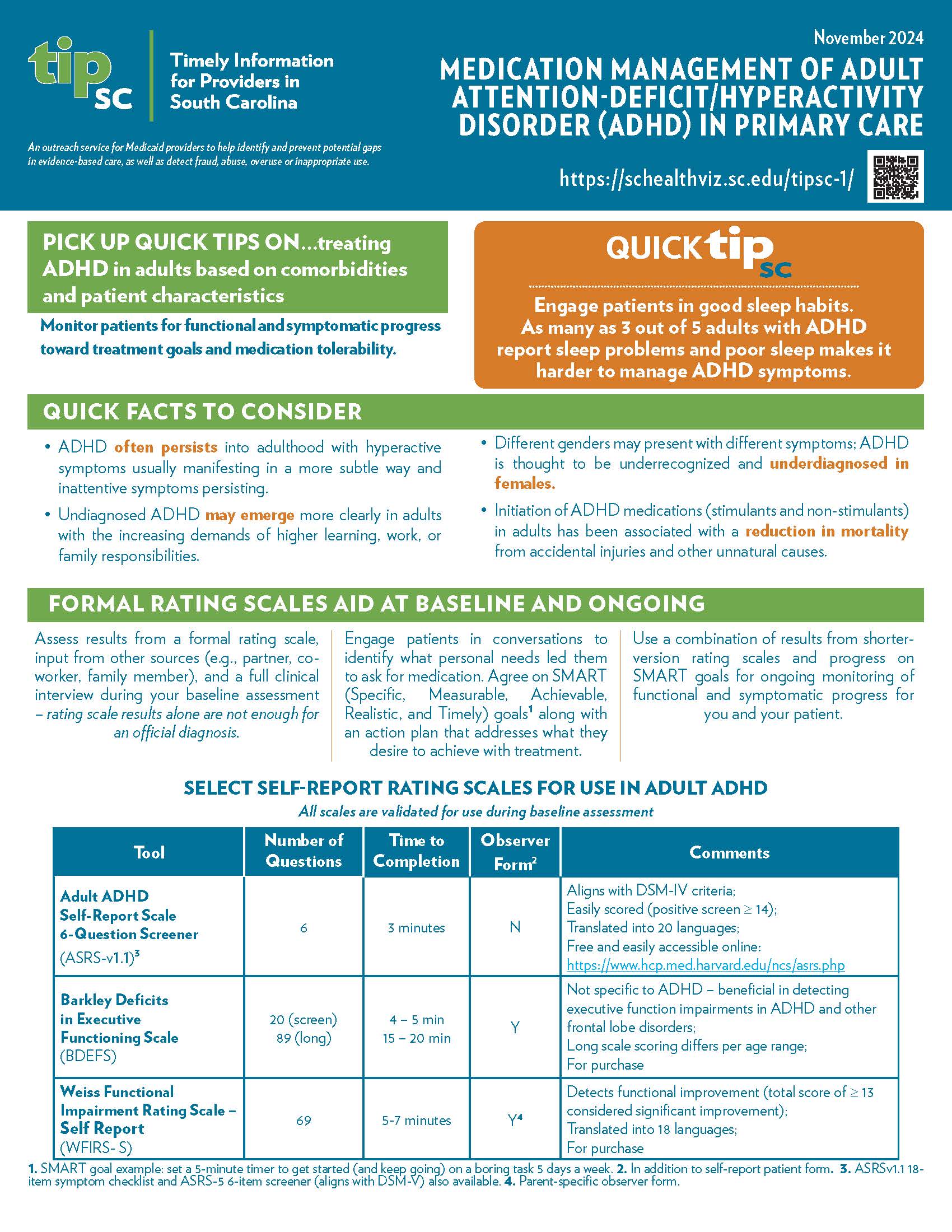
Activity Title: Medication Management
of Adult Attention-Deficit/Hyperactivity (ADHD) Disorder in
Primary Care (November 2024)
QUICKtipSC: : Engage
patients in good sleep habits. As many as 3 out of 5 adults
with ADHD report sleep problems and poor sleep makes it
harder to manage ADHD symptoms.
Publication Date: Nov. 30,
2024
Release Date: Jan. 6,
2024
Expiration Date: Nov. 30, 2027
Writing Group:
The
planners and writing group of this CME activity have no relevant
financial relationships to disclose with commercial interests:
Writing Group (and Disclosures for Pharmaceutical Relationships):
Sarah Ball, PharmD (none), Kelly Barth, DO (none), Sandra Counts,
PharmD (none), Nancy Hahn, PharmD (none), Jamie Hansen, Pharm D
(none), Lauren Linder Wier, PharmD (none), Jenna McCauley, PhD
(none), Joseph McElwee, MD (none), William Moran, MD (none), Megan
Pruitt, PharmD (none), Talisha Ratliff, PharmD (none), Sophie
Robert, PharmD (none), Elizabeth Weed, PharmD (none) Chris
Wisniewski, PharmD (none).
Objectives:
- Offer psychoeducation and non-drug strategies to all patients with ADHD, even before prescribing medications.
- Screen for co-occurring mental health conditions before prescribing ADHD medications to/and prioritize which condition to treat first; refer to a specialist when appropriate.
- Individualize ADHD medication selection based on patient’s goals, needs (e.g., window of effectiveness), and comorbidities.
- Use SMART (Specific, Measurable, Achievable, Realistic, and Timely) goals at baseline and ongoing to assess functional and symptomatic progress; adjust treatment plan as needed.
Credit
Designation
The Medical University of South
Carolina designates this enduring material for a maximum of 0.5
AMA PRA Category I Credit(s)TM. Physicians should
only claim the credit commensurate with the extent of their
participation in the activity.
Accreditation
Statement:
This activity has been planned and
implemented in accordance with the accreditation requirements and
policies of the Accreditation Council for Continuing Medical
Education (ACCME) through the joint providership of the Medical
University of South Carolina and tipSC. The Medical University of
South Carolina is accredited by the ACCME to provide continuing
medical education for physicians.
Disclosure Statement:
In
accordance with the ACCME Standards for Integrity and Independence
in Accredited Continuing Education anyone involved in planning or
presenting this educational activity will be required to disclose
any financial relationships with any ineligible companies. An
ineligible company is any entity whose primary business is
producing, marketing, selling, reselling, or distributing
healthcare products used by or on patients. This
information is listed below. Any financial relationships with these
ineligible companies have been mitigated by the MUSC Office of CME.
Speakers who incorporate information about off-label or
investigational use of drugs or devices will be asked to disclose
that information at the beginning of their presentation. The
faculty, staff, moderators, and planning committee for this
activity have no financial relationships with any ineligible
companies.
How to Earn CME
Credit:
Step 1: Access this issue
and supporting materials below:
- November 2024 - Medication Management of Adult Attention-Deficit/Hyperactivity Disorder (ADHD) in Primary Care (online view)
- November 2024 - Medication Management of Adult Attention-Deficit/Hyperactivity Disorder (ADHD) in Primary Care (print view)
- Select Resources to Support Adult ADHD Treatment in Primary Care (October 2024)
- ADHD Treatment Algorithm
- Guidelines For Switching Stimulant Adult ADHD Medications (Correction March 2025)
- Sleep and Adult ADHD Patient Handout (October 2024)
Step 2: If you wish to receive CME credit, click on the CME Tracker link below to receive a certificate upon completion of post activity questions and a course evaluation.
In CME Tracker, you will be directed to complete the following steps:
- Indicate whether you are a MUSC employee or not.
- Enter your last name.
- If you are an MUSC Employee, enter your 9-digit employee ID. If you are not an MUSC employee, enter the last four digits of your SSN.
- If you receive a notification that “no record has been found,” it means you have not yet created an account in the system. Click on “create an account” and complete the requested information. When done, refresh the page and complete steps 1-3.
CME Tracker – Claim Credit
Step 3: After successfully logging into CME Tracker, you will be directed to complete the post activity questions followed by the course evaluation. Upon completion of the evaluation, your certificate will automatically be posted on your screen.
Please make sure to print a copy of your certificate or save it as a PDF.